
CCSA Submission | Chuleng Shares Participates in Development of Multiple Communication Technology Standards
On 2023-7-31, Chuling Shares, as a member of the China Communications Standards Association (CCSA), submitted content via the CCSA Member Platform to showcase our company's significant progress in industry accumulation and R&D capabilities. This includes notable achievements in technological innovation, standards development, and product outcomes. Chuling Shares is committed to delivering three core edge computing capabilities: seamless intelligent connectivity, efficient data perception, and secure intelligent applications. We integrate a "cloud-edge-device" collaborative ecosystem, focusing on enterprise digital transformation and industry-specific edge intelligence markets. Our intelligent connectivity solutions extend communication networks into enterprises, enabling ubiquitous interconnection and intelligent scheduling to meet diverse digitalization scenarios. Since joining CCSA as a member, we have actively participated in relevant technical standards and research projects organized by the association, making meaningful contributions.
China's communication technology has advanced rapidly since the 21th century. Internet-based communication services have delivered a wide array of applications—including e-commerce, video conferencing, and voice calls—with great success. Most of these services demand high flexibility. In contrast, emerging systems in industry, agriculture, and services—such as smart manufacturing, autonomous transport, ultra-long-range control, remote healthcare, smart agriculture, and competitive gaming platforms—require deterministic communication with ultra-low latency, minimal jitter, and ultra-high reliability.
1. Chuling Shares' participation in the work of China's telecommunications standards organization
In 2016, Chuling Shares joined the China Communications Standards Association's TC6WG1 working group as member unit 1119, beginning to participate in discussions on technical standards related to SPTN, OTN, WDM, FlexE, OSU, and SPN.
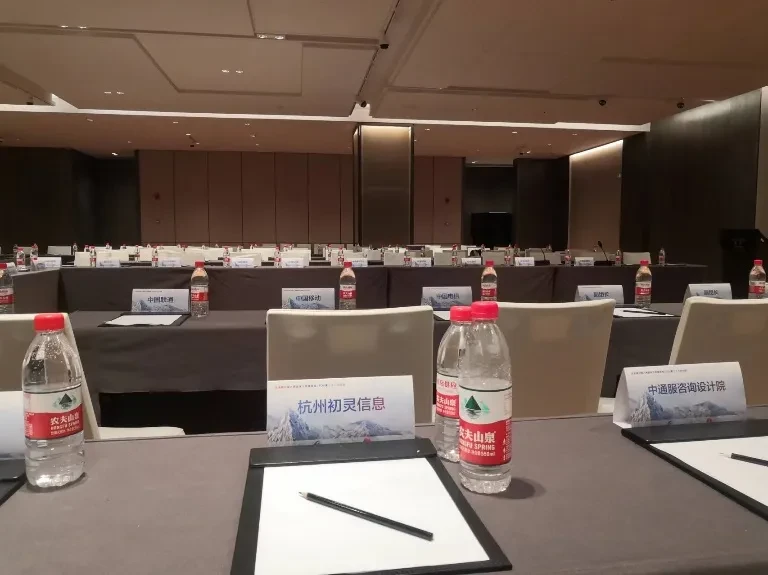
In 2020, Chuling Shares joined the TC3WG2 Working Group of the China Communications Standards Association, beginning to participate in discussions on technical standards such as IPv6/SRv6/ computing power routing.
2. Achievements of Chuling Shares in Domestic Standard Setting
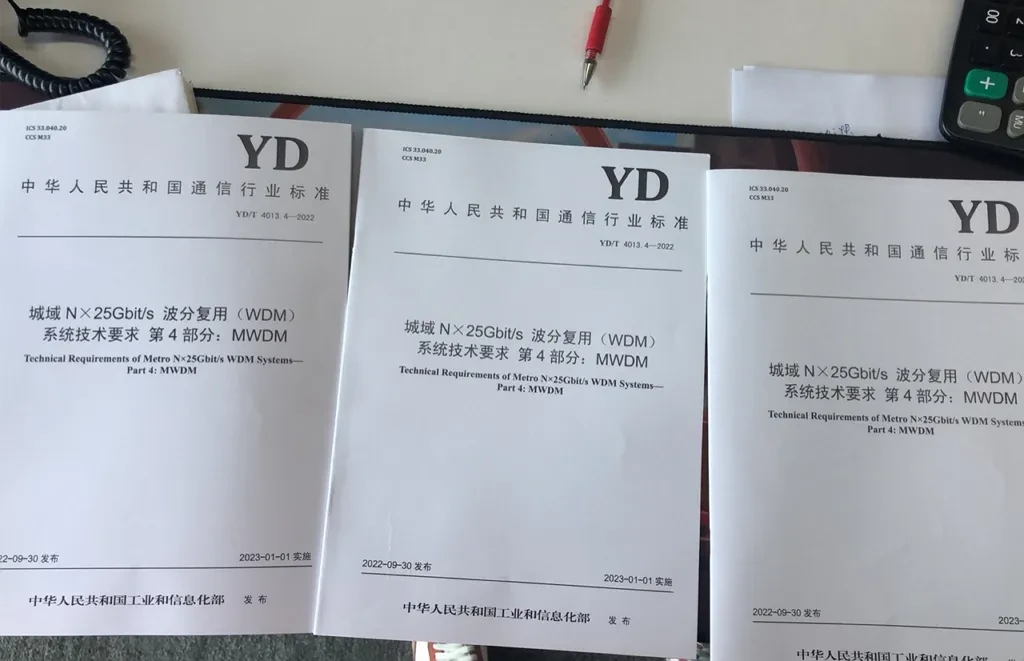
1) participated in drafting and reviewing the "Technical Requirements for 2020-0585T-YD Metropolitan N×25Gbit/s WDM Systems, Part 4: MWDM".
With the accelerated commercialization of 5G, N×25Gb/s WDM has become a leading line transmission solution for fronthaul networks beyond direct fiber connections. Neither passive nor fully active solutions adequately meet the low-cost and manageability requirements of 5G fronthaul. The semi-active MWDM approach combines controllability with wavelength-division multiplexing advantages. To promote stable industry development through domestic standardization, establishing N×25Gb/s MWDM semi-active standards is essential. This will help standardize China's high-speed optical transmission supply chain and promptly address the practical needs of 5G fronthaul in the country.
This standard has been officially published. Standard number: YD/T 4013.4-2022. This standard specifies the system architecture, transmission distance requirements, wavelength allocation scheme, networking methods, protection requirements, and power requirements for N×25Gb/s semi-active MWDM systems. It applies to N×25Gb/s semi-active MWDM systems.
2) participated in drafting and reviewing "H-202112062807_Slice Grouped Network (SPN) Fine-Grained Carrier Test Method".
Slice-based Packet Network (SPN) devices utilize MTN technology primarily in metropolitan networks to support 5G backhaul, industry virtual private networks, and dedicated enterprise lines. Based on time-slot channels of varying bandwidths, MTN technology partitions a single physical network into multiple virtual networks. Each virtual network is hard-isolated from the others, enabling support for distinct slice service types such as eMBB, URLLC, MIoT, and V2X. As 5G services and industry digital transformation continue to evolve, diverse vertical industries and enterprise/government clients also require slice isolation. Analysis of vertical application scenarios—including smart grids, smart ports, intelligent railways, smart healthcare, and financial dedicated lines—reveals that each industry will have hundreds or thousands of access points connecting to central data centers. Hard slicing remains essential between these access points to meet stringent requirements for latency, jitter, packet loss, and security.
In vertical industry use cases requiring low-latency, high-reliability control services and premium enterprise-grade dedicated lines, there is a clear demand for 2Mbps~1Gbps-granularity service transport that offers deterministic low latency and hard isolation. Therefore, we must accelerate the standardization of SPN fine-grained transport technologies to support Chinese operators in deploying these technologies, promoting their adoption, and conducting network equipment acceptance testing, thereby speeding up the deployment of 5G + vertical industry applications.
The draft for public comment of this standard has been approved at the 88th Working Group Meeting of TC6WG1. The submission version is scheduled to be presented at the 89th meeting.
3 as a participating organization, contributed to the drafting and review of "H-202205124033_Deep Packet Inspection Device O&M Management Interface Technical Requirements".
Deep Packet Inspection (DPI) devices are widely deployed in carrier networks for critical scenarios such as epidemic prevention and control, security monitoring, and operational analysis. Ensuring the reliable operation of DPI devices is essential; therefore, they must be monitored through management mechanisms to promptly detect anomalies in both equipment and data. Current industry standards primarily specify technical requirements related to DPI functionality, performance, and data interfaces but lack unified specifications for operations and maintenance (O&M) interfaces. As a result, carriers currently define their own O&M interfaces independently, which typically cover basic metrics like device status and server CPU utilization. However, these proprietary definitions often omit critical interface specifications for call detail record (CDR) generation, upload, and data quality. Establishing relevant standards will drive advancements in DPI technology and enhance the overall management capabilities of DPI systems.
This standard was approved for project initiation at the 53 Working Group meeting held in TC3WG2, with a draft for public comment scheduled for submission at the 57 meeting.
4, as a member of the China Communications Standards Association (CCSA), submitted and had adopted review comments on the following standard documents during CCSA meetings.
Meeting TC6WG1 of Session 79: Discussed the draft "Test Methods for Precision Time Protocol (PTP) Boundary Clocks and Slave Clocks on Grouped Carrier Equipment" (1T-YD). Infocus Corporation's 1 feedback items were accepted.
TC6WG1 82 Meeting: Reviewed the draft "Technical Requirements for Slice Grouping Network (SPN) Equipment" (2019-1218T-YD). Infinita Corporation's 1 feedback suggestions were accepted.
TC6WG1 Meeting 82: Discussed the draft "Test Methods for Slice Packet Network (SPN) Equipment" for 2T-YD. Infinitus provided 2 feedback suggestions that were accepted;
TC6WG1 Meeting 86: Discussion of the Draft for Comments on "Fine-Grained Carrier Technology Requirements for Slice Packet Network (SPN)" 2021-096, with 5T-YD. Chuangling Shares had 2 feedback points accepted.
TC6WG1 Meeting 86: Reviewed the draft "Technical Requirements for Control and Management of Access-type Optical Transport Network (OTN) Equipment" (2019-1216T-YD). Inphonic Co., Ltd. submitted 1 feedback points, all of which were accepted.
TC6WG1 87 Meeting: Reviewed the draft "Technical Requirements for Fine-Grained Carrying of Slice Packet Network (SPN)" (2021-0965T-YD). Intellifusion submitted 1 feedback items, all of which were adopted.
TC6WG1 Meeting 87: Discussed the draft "Test Method for SPN Southbound Interface" for 2021-096 6T-YD; Chulink Corporation's 10 feedback points were accepted.
TC6WG1 88 Meeting: Review of the "Synchronous Network Terminology and Definitions" Draft for Submission. Inspur Digital Solutions proposed 1 feedback items, all of which were adopted.
TC6WG1 88 Meeting: Reviewed the draft "Test Methods for SPN Southbound Interface" (6T-YD). Chulink Co. submitted 3 feedback points, all of which were accepted.
Chuling actively participates in standardization activities organized by the China Communications Standards Association and will dedicate more efforts to emerging fields such as SPN/OTN/SRv6/ computing power routing, making greater contributions to China's informatization and information industry development.