
Industry Insights | When Computing Power Becomes the Pulse of Industry: Building the Factory of the Future

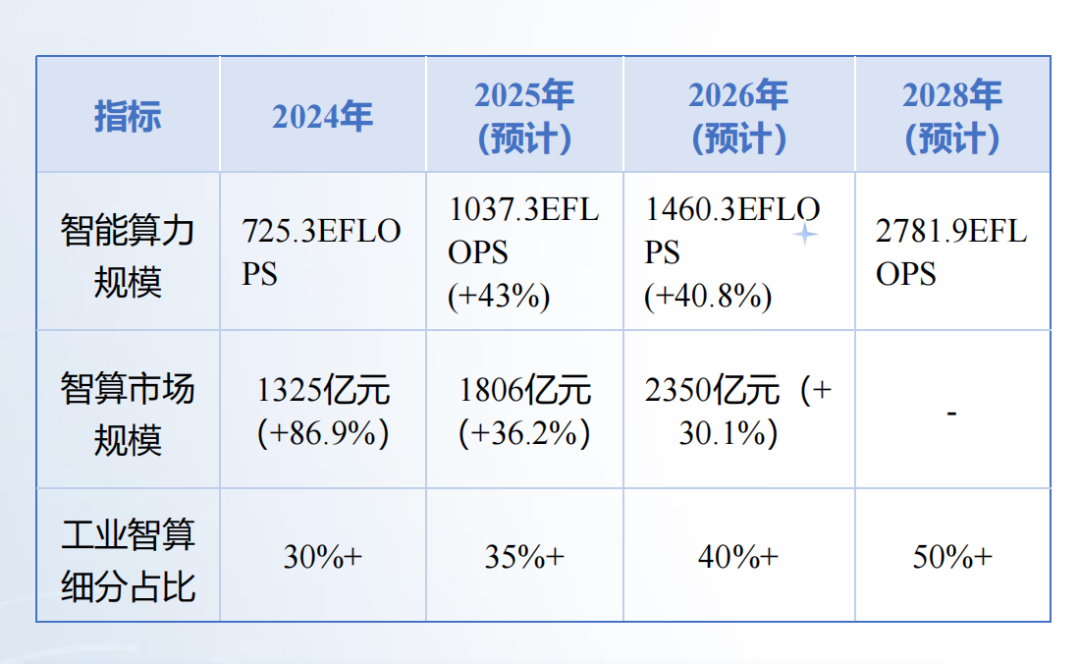
According to the latest "Industrial Intelligence Computing Development Research Report" released by the China Academy of Industrial Internet, a fundamental shift centered on "computing power" is underway. The report indicates that the scale of intelligent computing in 2025 is expected to reach 1037.3EFLOPS, with projections suggesting it could surpass 2781.9EFLOPS by 2028. Among these developments,2025—2028: Over 35% of computing power will directly serve the industrial sector.
01 Why Industrial AI Computing Is Essential
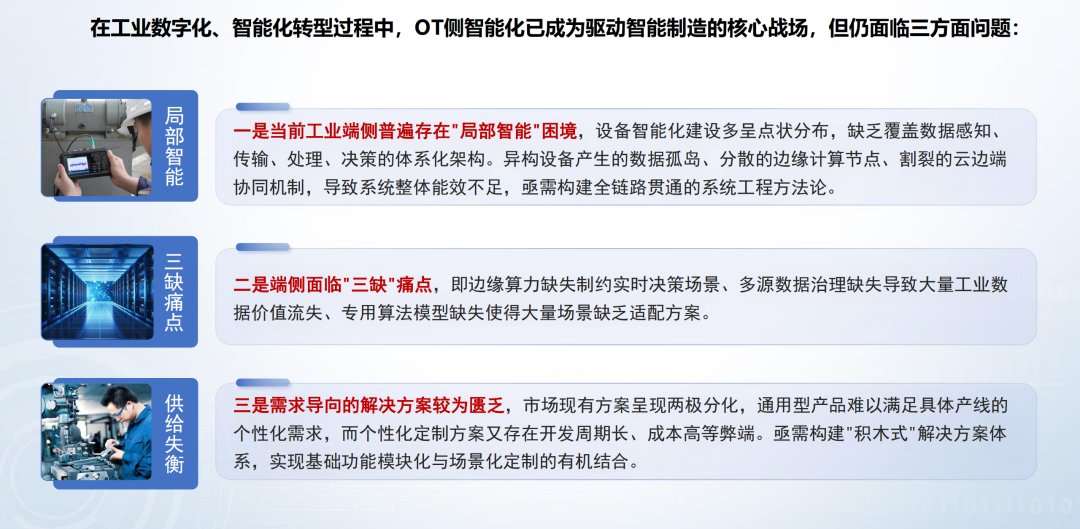
For years, industrial intelligence has faced a frustrating dilemma: "fragmented intelligence." Many factories deploy smart cameras or robotic arms, but without a systematic architecture covering data sensing, transmission, and processing, devices operate in silos, creating countless "intelligence islands."
Additionally, the industrial edge faces three critical gaps: lack of edge computing limits real-time decision-making, absence of multi-source data governance causes value loss, and missing specialized algorithm models hinder scenario-specific adaptation.
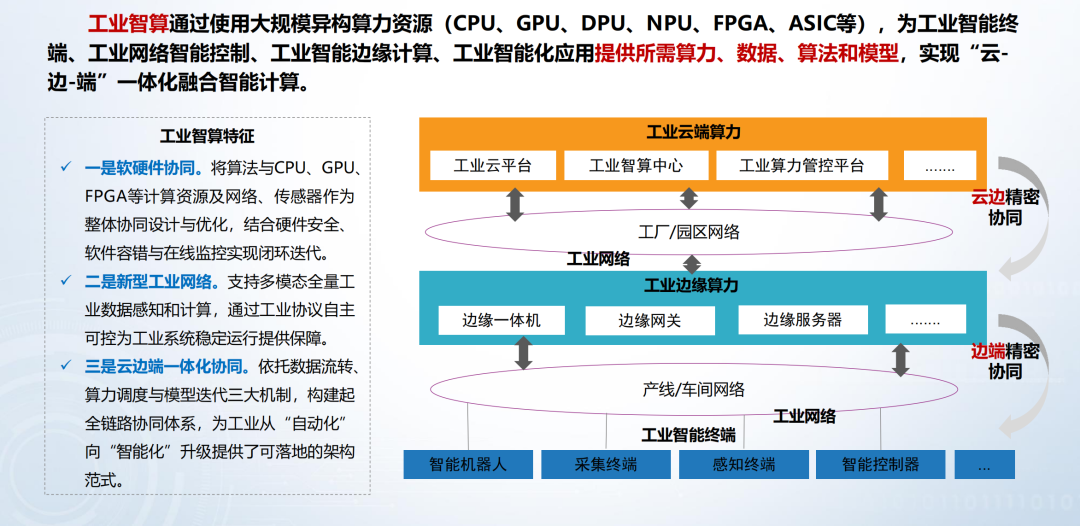
The advent of industrial AI computing has effectively solved these pain points. ItLeveraging large-scale heterogeneous computing resources (e.g., CPU, GPU, NPU), we have built an integrated "cloud-edge-end" architecture that provides a complete foundational framework for industrial production.The edge device handles real-time data perception, the edge server delivers millisecond-level decision responses, and the cloud manages large-scale model training and global optimization. Instead of uploading anomalous data to the cloud for analysis, decisions are now made instantly right next to the machine. By shifting decision-making closer to the source, industrial production is truly evolving from "mechanical execution" to "intelligent collaboration."
02 Global Game: Two Approaches from the US and Europe
On the global stage of industrial intelligence computing, the United States and the European Union are pursuing distinctly different development paths.
The U.S. is pursuing a path of "technological hegemony."With 68.9% of global AI computing power, industry leaders have achieved vertical integration, controlling the entire value chain from chip design to software services. They prioritize "extreme performance," obsessing over larger-scale computing clusters and more disruptive chip architectures, aiming to dominate the peak of general artificial intelligence.
The EU chooses a path of "precision sustainability".The EU favors distributed collaboration, prioritizing precise services for SMEs. It prioritizes RISC-V ecosystem development and neuromorphic chips while establishing core competitive advantages in compliance and green computing (PUE < 1.3). The core focus is ensuring industrial security and sustainable development.
03 China Track: Explosive Demand and Supply Chain Growth
China's industrial intelligent computing is driven by powerful momentum, entering a window period for simultaneous growth in scale and quality.
On one handIt is driven by the deluge of industrial data. In 2024, China's industrial big data market size exceeded 1200 billion yuan, and it is projected to reach 1600 billion yuan in 2025. There are now over 3.5 high-quality industrial datasets with a total volume exceeding 400 PB, covering key sectors such as steel, petrochemicals, and coal mining.
On the other handAs digital transformation deepens from finance and management systems into core production lines, real-time intelligent decision-making at the edge becomes essential. According to the report, in the second half of 2024, the market for generative AI infrastructure services tailored to industrial scenarios grew by 165.2% year-over-year, reaching a size of 87.4 billion yuan. Industrial enterprises are accelerating the adoption of generative AI in key areas such as automated content generation, intelligent decision support, and digital twin modeling.
The explosive growth in market demand has also driven the rapid development of domestic supply chains.On the supply chain side, domestic AI chips now account for 42% of industrial intelligent computing, liquid-cooled server penetration has risen to 64%, and single-machine computing power has reached PF levels. A self-reliant, collaborative industrial intelligent computing ecosystem is taking shape—challenging yet powerful.
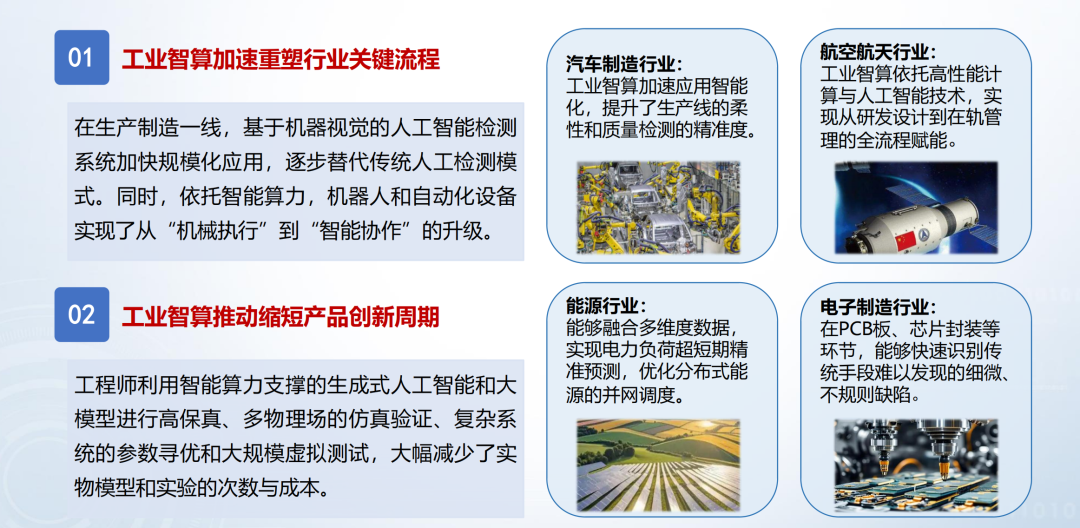
At the industry application level, industrial intelligence has already unlocked core value across multiple key sectors.In automotive manufacturing, intelligent computing enhances production line flexibility and quality inspection accuracy. In aerospace, it enables end-to-end capabilities from R&D design to in-orbit management. In energy, multi-dimensional data fusion achieves ultra-short-term precise load forecasting and optimizes grid integration scheduling for distributed energy. In electronics manufacturing, it rapidly identifies microscopic defects on PCBs and chip packages.
04 The Future is Now: Trends in Industrial Intelligent Computing
According to the report, future industrial intelligent computing will exhibit four core trends. The period from 2026 to 2027 will be a critical window for "technology fusion explosion and ecosystem collaboration breakthrough."
Computing power networks evolve from distributed deployment to millisecond-level global coordination.City-wide millisecond computing will achieve large-scale deployment, integrated compute-network services will become widespread, and the barrier to using computing power will drop by 60%, meeting industrial demands for low-latency, high-reliability computing.
The "Super Brain" is taking shape on the factory floor.Industrial agents will become the "super brain" driving industrial transformation, enabling future factories to achieve a fully closed-loop process of autonomous perception, decision-making, and execution.
China's domestic ecosystem evolves from isolated breakthroughs to coordinated collaboration.Alliance-based development is becoming mainstream. China's industrial intelligent computing will leap from "point-specific substitution" to "full-domain domestic substitution." Meanwhile, the standards framework is accelerating its refinement, with unified standards for industrial data classification and grading, interface protocols, and more providing the foundation for ecosystem collaboration and full-domain adoption.
From key industries to deep, comprehensive penetration across the entire sector.The industrial AI computing sector will extend to traditional industries such as textiles, light industry, and agriculture. Application scenarios will evolve from single-process intelligent upgrades to full-process empowerment in complex environments, delivering significantly greater value in core areas like energy optimization and safety management.
When computing power truly integrates into the pulse of industry, future factories will no longer be cold arrays of machines. Instead, they will become living, breathing organisms—perceptive, intelligent, and collaborative. Industrial intelligence computing is the "lifeblood" that powers this transformation.
*The above content and data are sourced from the "Industrial Intelligent Computing Development Research Report" released by the China Academy of Industrial Internet.
In this wave of industrial transformation centered on computing power,Chu Ling can alsoLeverage existing capabilities,Deliver practical, scalable solutions for industrial enterprises in integrated computing-network and edge computing.Comprehensively meets industrial demands for low-latency real-time control and high-compute deep analytics.